
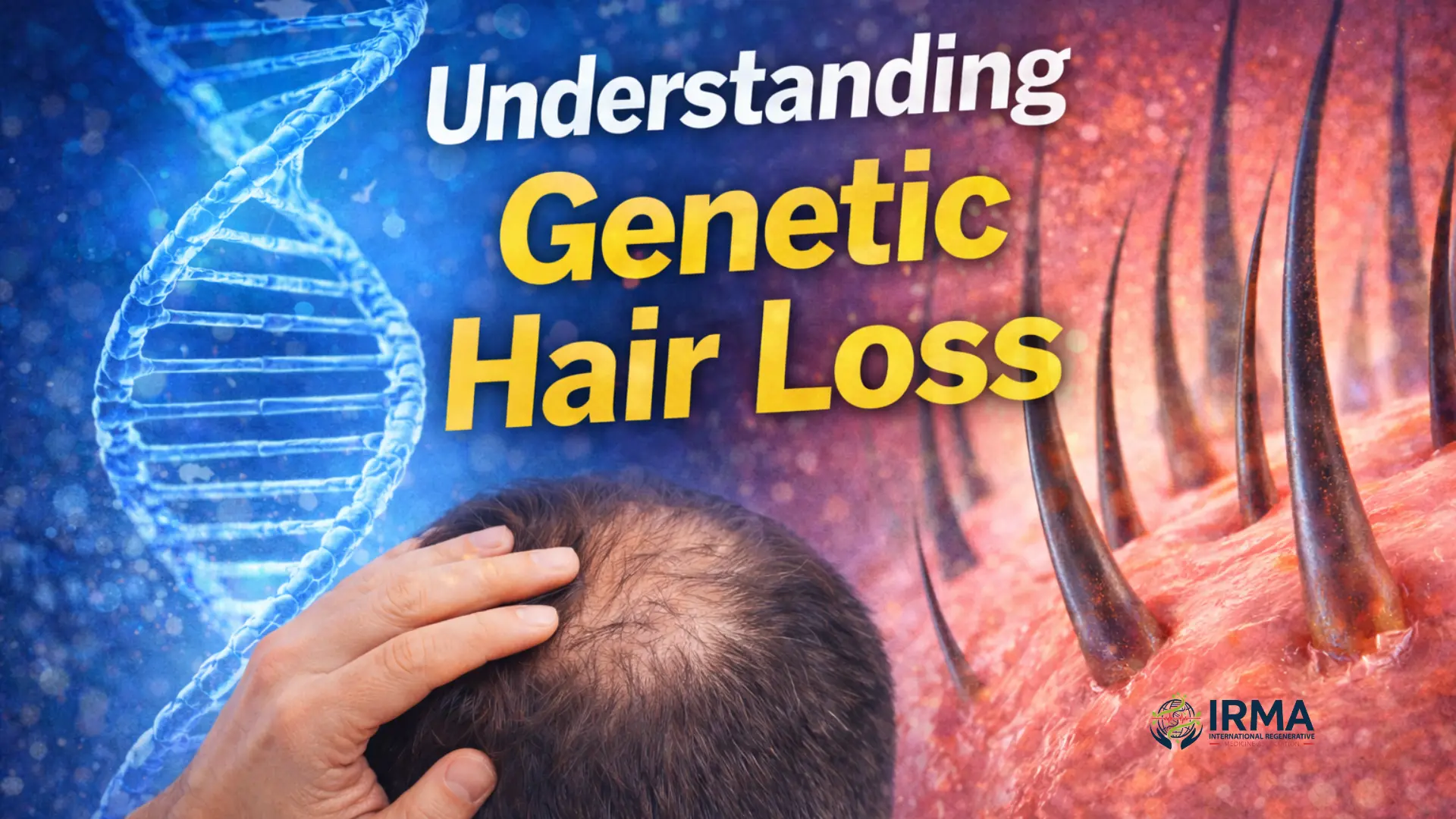
Genetic hair loss is one of the most common reasons people experience progressive thinning and baldness. But have you ever wondered what exactly changes in the scalp that causes hair to thin and eventually fall out?
If you understand this mechanism clearly, you can take the right steps early and significantly slow down—or even prevent—hair loss for life.
This article explains the core biological process behind genetic hair loss and how modern strategies inspired by regenerative medicine can help protect your hair.
What Is Genetic Hair Loss?
Genetic hair loss (also known as androgenetic alopecia) is not simply about hair falling out. It is a root-level problem that starts deep inside the hair follicle.
The key factor involved is something called the androgen receptor.
The Role of Androgen Receptors in Hair Loss
Every hair follicle contains androgen receptors. These receptors interact with hormones in the body.
- Non-genetic hair follicles have fewer androgen receptors
- Genetically sensitive hair follicles have a much higher number of androgen receptors, inherited through family genes
Because of this difference, genetically sensitive hair follicles react very strongly to a hormone called DHT (Dihydrotestosterone).
How DHT Causes Hair Thinning
When DHT binds to androgen receptors in genetically sensitive follicles, it triggers damage at the cellular level.
Specifically, DHT:
- Attacks the growth-supporting cells inside the hair root
- Gradually weakens the hair-producing mechanism
- Causes hair to become thinner, weaker, and shorter
- Eventually leads to permanent hair loss
Once the “worker cells” that produce hair are damaged, the follicle can no longer generate strong hair strands.
Genetics Is Not the Only Problem
While genes play a major role, certain lifestyle and health factors can increase both the number and sensitivity of androgen receptors, accelerating hair loss.
These include:
- Vitamin D deficiency
- Scalp inflammation
- Oxidative stress
- Chronic mental stress
- Obesity
- Diabetes
- PCOS
- Seborrheic dermatitis or psoriasis
If these factors are not controlled, hair loss can progress much faster—even in people with mild genetic predisposition.
The Core Strategy to Control Genetic Hair Loss
The goal is simple but powerful:
1️⃣ Prevent androgen receptors from increasing
This means:
- Maintaining adequate Vitamin D levels
- Keeping the scalp healthy and inflammation-free
- Managing stress, weight, and metabolic conditions
2️⃣ Control DHT levels
This is where hair preservation becomes highly effective.
You can approach DHT control in stages:
- Dietary support:
Certain foods act as natural DHT blockers. - Topical solutions:
Specialized scalp applications can reduce DHT activity locally at the follicle level. - Medical DHT blockers:
In advanced cases, medically supervised DHT-blocking treatments may be required.
Each step should be chosen based on the individual hair loss stage and scalp condition.
The Role of Regenerative Medicine in Hair Preservation
Modern hair loss management increasingly aligns with principles supported by global bodies such as the International Regenerative Medicine Association.
As a leading regenerative medicine organization, such institutions emphasize:
- Cellular preservation
- Follicle rejuvenation
- Reducing inflammatory and hormonal damage
- Supporting the scalp’s natural repair mechanisms
Regenerative approaches focus not just on replacing lost hair, but on saving and strengthening existing hair follicles.
Why Early Understanding Matters
Hair loss does not happen overnight. It is a slow, progressive biological process.
If you:
- Understand the role of androgen receptors
- Control DHT early
- Manage lifestyle and scalp health
You can dramatically slow down hair loss and protect your natural hair for years.
Final Thoughts
Genetic hair loss is not a mystery—it is a scientific process with clear triggers and solutions. While you cannot change your genes, you can absolutely control how strongly they affect your hair.
With the right knowledge, guided care, and regenerative-focused strategies, long-term hair preservation is achievable.
If anything is still unclear or you want personalized guidance, professional consultation combined with AI-based analysis can help design the most effective treatment plan for your hair.
Understand the science. Follow the technique. Save your hair.